It is often claimed that putting money into investments helps it increase. Yet questions remain about location, method, quantity. A key consideration involves timing – starting slowly through regular payments might differ from placing everything at once. Deciding between these approaches requires attention to personal circumstances. The choice rests not on trends, but on individual patterns of income and risk comfort. What works for one may not suit another. Timing, consistency, and uncertainty shape outcomes just as much as the initial decision to begin.
This problem finds resolution in a single option – the SIP and Lump Sum Calculator. With it, growth paths of funds become visible, depending on approach taken and duration involved. Where results emerge depends entirely on timing plus investment style.
SIP & Lumpsum Calculator
Understanding SIP and lump sum calculators?
Suppose there exists a sum of fifty thousand rupees. One possibility appears on the left, another on the right
- SIP: Invest ₹5,000 every month in mutual funds
- Lump Sum Investing Full Fifty Thousand Rupees At Once
After five years, consider which method yields greater returns. Working it out by hand takes time. For this reason, a tool compares SIP against lump sum instantly. Results appear quickly, showing the clearer choice. The decision becomes simpler with accurate comparisons.
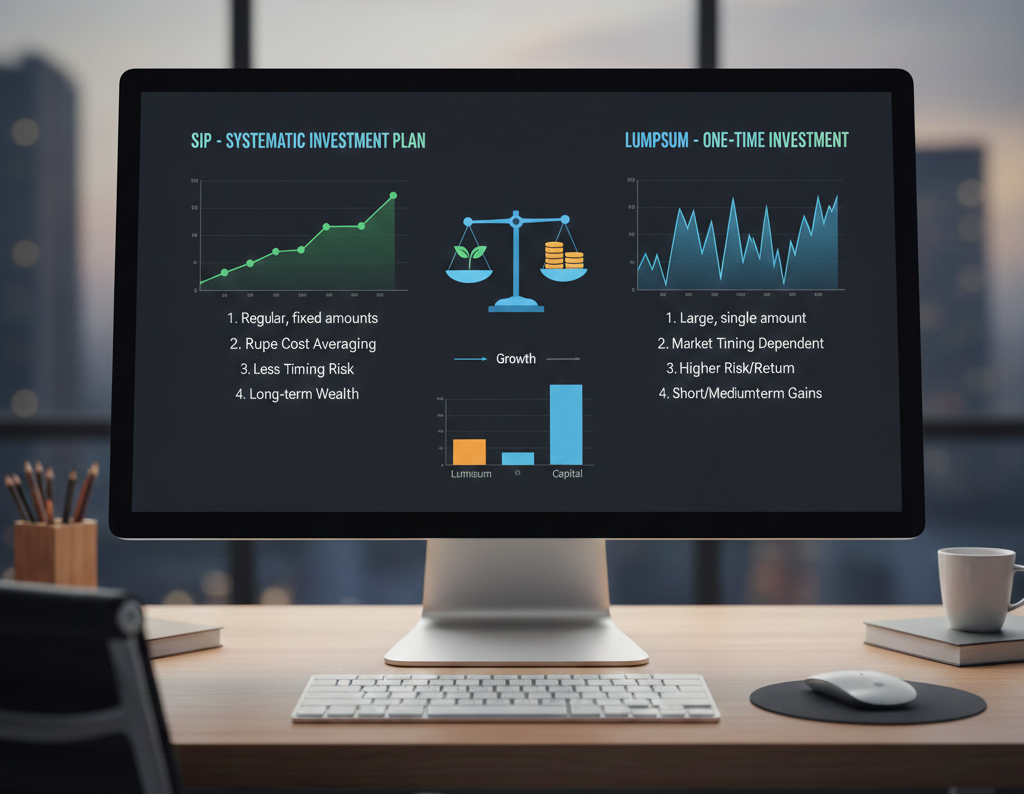
Basic Differences:
SIP Calculator Monthly Investments
Lump Sum Calculator One Time Investments
- Combination Calculator: To see a mix of both strategies
Using the Calculator Step by Step
Scenario: Raj, age 28, IT engineer, has savings of ₹2 lakh
Define Your Goals
A vehicle purchase may happen within three years at most. This goal could take shape after one year has passed. Three years is the outer limit for completing this plan. One year might be enough time to prepare fully
Marrying within a few years stands as one goal. Three to seven spans mark the period. Plans take shape slowly during this stretch. Commitment forms through time, not haste. Events unfold without rush when dates align naturally
- Long term (7+ years): Retirement planning
Enter values in calculator
For SIP Calculation:
Monthly Investment Ten Thousand Rupees
- Period: 15 years
Expected Annual Return 12 Percent
Displayed outcome from the device:
Total Invested 18 lakh rupees
Estimated Returns ₹25 30 000
Total Value 43 Million Rupees
Lump Sum Calculation
One Time Investment Two Hundred Thousand Rupees
- Period: 15 years
Expected Annual Return 12 Percent
Output displayed through calculation tool:
Total Invested 200000
Estimated Returns ₹10 95 000
Total Value 12 Million Rupees
Step 3: Compare
Every month, a sum of ten thousand rupees put into a SIP could become forty-three lakh rupees after fifteen years
A single payment of two hundred thousand rupees could become thirteen lakh rupees over fifteen years. Growth occurs gradually without additional contributions. The amount increases solely through accumulated value over time. Initial investment remains unchanged throughout the period. Final sum reflects long-term progression under steady conditions
Advantages of Using a SIP Calculator
- Builds Discipline
A sum of ₹15,000 invested monthly over two decades may become roughly ₹1.45 crore, given a 12% return. Over time, regular deposits encourage consistent behaviour. Despite market shifts, discipline often supports long-term results. - Compounding Shows Its Strength
Over five initial years, six hundred thousand rupees were allocated, resulting in four hundred fifty thousand returned. Though capital entered early, gains emerged slowly across the period. Money moved in steadily, yet earnings lagged behind total input. During this phase, inflows exceeded outcomes by a notable margin. Eventually, returns began aligning closer to investment levels
Over the coming half-decade, a sum of six hundred thousand rupees placed into investment yields nine hundred eighty thousand in return
- Last 5 years: ₹6 lakh invested → ₹17.2 lakh returns
Time passing increases compound gains. As duration extends, growth builds more fully. With each added period, results grow larger. Progress rises steadily when intervals stretch out. Greater spans allow effects to deepen further.
- Goal-Based Planning
- Buy car in 3 years: ₹15,000/month @ 10% → ₹6 lakh
- Child’s education in 15 years: ₹10,000/month @ 12% → ₹50 lakh
- Retirement in 30 years: ₹20,000/month @ 12% → ₹7.2 crore
- Helps Beat Inflation
A sixth of inflation eats into half the gain when twelve percent growth faces six percent rise. What remains reveals purchasing power after costs erode value. Future needs shape today’s amounts through gradual reduction by rising prices. Numbers adjust automatically based on time and expected change ahead. - Risk Management
Over time, investing a fixed amount regularly smooths volatility. Despite shifting conditions, steady contributions help maintain balance through change.
Lump Sum Calculator Advantages
- Manage Windfall Gains
Should extra funds arrive – through windfall, sale proceeds, or family transfer – a tool reveals outcomes if fully committed immediately. Growth unfolds based on that single entry point into markets. - Highlights Timing Importance
Lump sum investing may offer better outcomes when prices are down and funds are available. Shown through projections, placing money in during dips could lead to higher gains over time. - Less Monitoring Needed
A single investment covers everything. Returns appear ahead of time, revealed by the tool without ongoing checks.
SIP vs. Lump Sum Comparison
Income that comes each month fits well here. Occasional larger sums find their place there instead.
Timing matters less when costs are smoothed over time. Still, entering at lower levels can improve outcomes somewhat. Periods of reduced valuation tend to support stronger later returns. Consistent entry removes reliance on precise forecasts entirely. Higher points may limit initial growth potential noticeably. Fluctuations become less influential when pace is steady. Opportunity exists regardless, yet sequence affects results eventually.
Consistency shapes how people approach investment routines. Over time, small actions create patterns that stick. A single decision made once can shift long-term direction.
On balance, exposure diminishes through gradual entry. Should prices drop post-commitment, vulnerability increases. Averaging softens downside impact over time. Sudden declines soon after allocation elevate potential loss. Gradual positioning reduces overall threat level. Market weakness following deployment raises risk severity
Flexibility allows changes in investment size. Meanwhile, a set sum remains unchanged regardless of conditions. Amounts adapt when needed instead of staying constant
One aspect involves liquidity. A monthly obligation exists as part of the structure. The full sum is secured right at the start
Frequently Asked Questions
SIP Or Lump Sum Which Is Better
It depends:
Luckily receiving steady earnings? A SIP might suit more.
Occasionally, receiving everything immediately proves preferable. When quantity is substantial, one full payment could suit more. Sometimes splitting makes less sense than taking it whole. If size matters, a single disbursement might work best. Rarely does dividing benefit outweigh total upfront receipt.
A balance between the two tends to work best. Comparison can be done through the tool provided. Despite differences, each approach has merit when applied appropriately.
Expected Return Rate To Enter For Q2
Past records indicate:
- Equity mutual funds: 12–15% long term
- Debt funds: 7–9%
- Hybrid funds: 9–12%
Planning realistically means working with a range of ten to twelve percent.
Calculator Accuracy Explained
Accuracy ranges near eighty to eighty-five percent over extended periods. Though results shift, the projection remains grounded in reality.
How Taxes Are Handled
Good calculators include tax impact:
LTCG 10 percent on profits over one lakh rupees
STCG Short Term 15 Percent
Calculations handled individually where tax-saving funds are involved.
Is Inflation Adjustment Necessary
A sum of one crore rupees at present does not hold the same value it will two decades ahead. Accurate tools account for purchasing power shifts over time. One might consider a six percent annual decline in value typical for India’s economy. These estimates reflect how money loses reach when prices rise steadily.
Increase SIP Over Time
One year at a time, growth continues steadily. Beginning at ₹10,000 per month, adjustments follow annual cycles – over two decades, results may reach ₹1.8 crore rather than ₹1.2 crore.
Withdrawal Options Available
Indeed. Certain calculators display SWP – indicating the monthly withdrawal amount during retirement alongside duration estimates for fund depletion. Yet functionality varies across tools depending on inputs such as inflation assumptions, return rates, and initial capital size. While one tool might project a 25-year lifespan of funds, another could suggest 18 years under differing conditions. Such variation emerges not from design flaws but from distinct modeling approaches underlying each system. Occasionally, results shift when tax implications or sequence-of-returns risk enter calculations. Therefore interpretation requires attention beyond output alone, focusing instead on structural logic guiding outcomes. Even seemingly identical tools may yield divergent projections due to subtle algorithmic differences hidden beneath interfaces.
Handling several sip plans at once
Use the calculator for different goals:
- Goal 1: Child education – ₹15,000/month
- Goal 2: House down payment – ₹20,000/month
Retirement Goal Targeting ₹25,000 Monthly Income
Market crash what happens
In the case of SIPs, ongoing investment maintains consistency. When prices drop, more units are acquired automatically. Those entering via lump sum could face negative outcomes when markets retreat after high-point entry.
Best Calculators Explained
- Value Research Online Detailed For India
- Moneycontrol SIP Calculator Easy to Use
- ET Money Calculator Displays Visual Graphs
- Bank and AMC sites like SBI HDFC ICICI offer useful calculators

Smart Tips For Using The Calculator
- Goal-Based Planning
SIPs can align with distinct objectives through varied contributions. When timing differs, allocations adjust accordingly. Each target shapes its own rhythm of investment. Periodic inputs follow individual schedules without overlap. Structure shifts based on purpose, amount, and duration. Goal-specific planning defines the flow. Separate aims lead to unique pacing patterns. - Step-Up SIP Planning
Each year, adjust your SIP upward when earnings rise. For instance:
For the initial five years, ten thousand rupees are paid every month
From Year 6 through Year 10, the amount required each month is fifteen thousand rupees
- Years 11–15: ₹20,000/month
This shift may greatly increase the size of your end collection.
- Test Asset Allocation Mix
Experimenting with various portions of ownership versus borrowing helps adjust potential gains against uncertainty. Sometimes more debt means higher reward, though exposure grows. Shifting the mix influences outcomes in unpredictable ways. - Manage retirement withdrawals
Monthly withdrawal amounts appear clearly when applying SWP calculator tools. These estimates help preserve the original investment sum over time. One discovers limits by entering figures into such systems. Withdrawal planning gains precision through numerical feedback. Preservation of capital emerges as a result of structured output. Input leads to insight on sustainable payout levels. The tool reveals boundaries tied to lasting funds.
Common mistakes to avoid
Overestimating potential gains often leads to disappointment. A more reasonable range settles around ten to twelve percent annually. Returns near twenty or twenty-five are uncommon over time. Patience tends to align better with actual market behavior. Extreme figures rarely reflect sustained outcomes.
- Not having an emergency fund before starting SIP.
- Skipping insurance (term insurance) before investing.
Early termination of SIPs disrupts sustained growth patterns. Long-term consistency brings measurable outcomes. Patience over time replaces quick decisions. Results emerge only after repeated commitment. Delayed rewards often outweigh immediate exits. Duration matters more than initial intensity.
One approach might be sip alone, yet another chooses lump sum exclusively. A blend of both methods tends to serve more effectively at times. While one method focuses on consistency, the other values timing differently.

I am Yallappa Bichagatti and i’m seasoned financial professional with over 13 years of extensive experience in the banking and finance sector. Throughout his career, he has held key positions in Retail Banking, Wealth Management, and Corporate Finance, where he specialized in tax optimization, investment strategies, and large-scale portfolio management. Driven by a mission to bridge the gap between complex financial regulations and the common man, he founded karnatakaland.in to provide simplified, data-driven utility tools