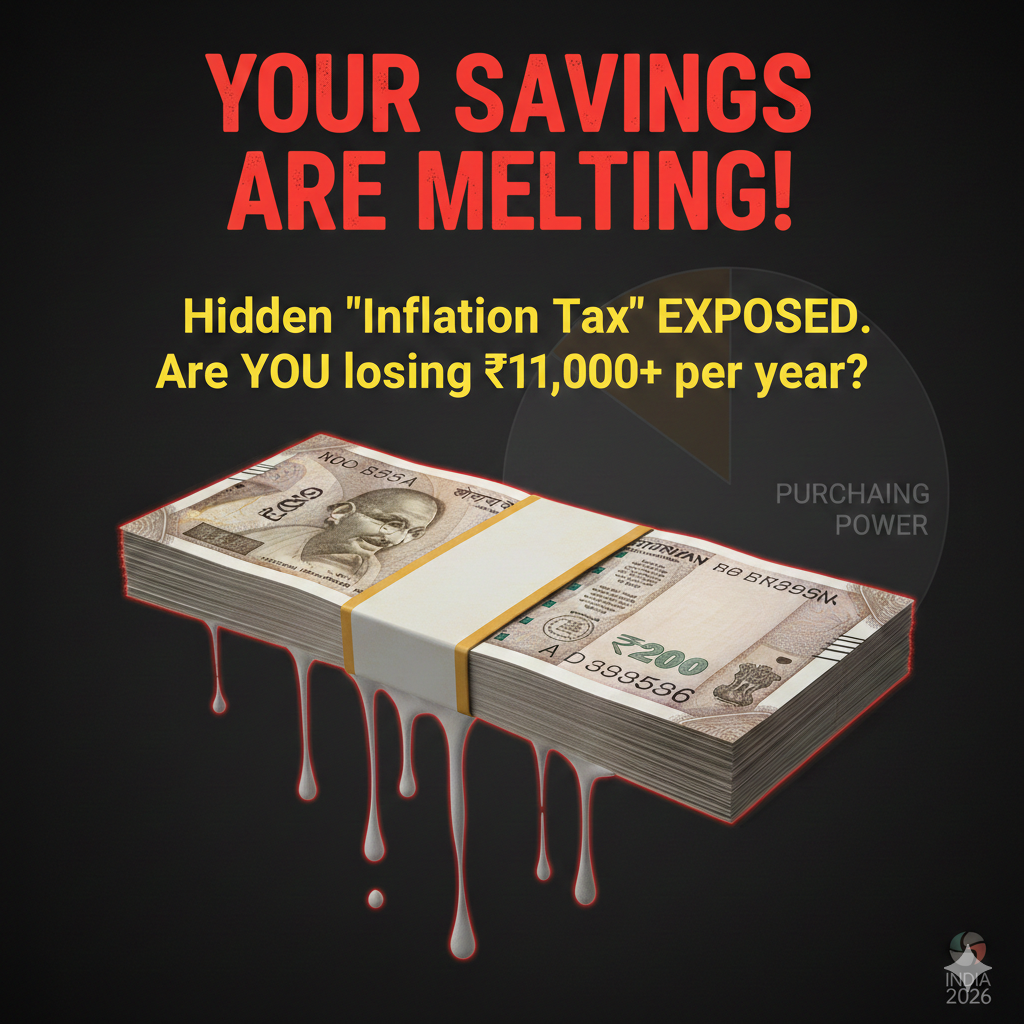
One reason this subject matters now? It hits a blind spot in how most people in India view money. Satisfying as it feels to watch digits grow in a bank statement, few ask what those numbers can actually buy. What if gains on paper hide real losses behind rising prices? Evidence from early 2026 shows accounts earning less than inflation slowly shrink value over time.
Every day, millions of people place their earnings into savings accounts – this step feels safe, familiar. Numbers on a screen rise slowly over time; that small gain brings comfort to many households across India. Yet somewhere beyond the usual routine, something shifts by 2026.
The Inflation Tax Is the Real Issue
Imagine peeling back layers of how cash really behaves over time. What happens to one hundred thousand rupees when five years pass? A number like 4% might seem safe, yet quietly erodes worth in current economic conditions across India. Think differently about returns. Value shifts when inflation steps in.
- Purchasing muscle weakens even when deposits appear stable.
- Slow erosion often escapes notice until larger goals become harder to meet.
- The effect grows steeper each year rates lag consumer price trends.
India Faces Higher Prices Now
Now it looks different, since adjustments arrived in 2026. Updated figures trace spending habits through a revised base – shifted by the Ministry of Statistics – from 2012 up to 2024.
- Food and Drink: Now weighing less in the calculation, food and drink make up just over a third of the inflation index – down from nearly half before.
- Modern Consumption: A fresh update brings current spending habits into view – smartphones appear alongside streaming services and e-commerce buys. Outdated entries such as VCRs no longer make the list.
- Current Data: In early 2026, consumer prices rose just 2.75%, according to updated data released recently. Still, that small figure might be misleading. Lately, it has settled closer to 4.6%, rising toward 5.4%.
The Great Erosion: How Much ₹1 Lakh Can Buy After Five Years
To figure this out, a reasonable guess about rising prices is necessary. Given past patterns over the last decade along with current movement, an estimate of 5.5% fits well. This will be measured next to what many earn in standard bank accounts – around 3.0%, once taxes are accounted for.
Read More : https://karnatakaland.in/why-indian-home-sellers-could-lose-lakhs-in-fy-2025-26/
Scenario A: The Saver With Money in a Savings Account Earning 3 Percent
You deposit ₹1,00,000 today. Five years later, the amount reaches about ₹1,15,927. Imagine thinking you’ve gained ₹15,927. That number looks good at first glance – yet it’s only on paper.
Scenario B: How Inflation at 5.5 Percent Affects Living Costs
Five years down the line, rising prices could push the cost of today’s ₹1,00,000 shopping bundle close to ₹1,30,696. What feels affordable now might feel heavier on wallets later.
The Real Worth of What You Save
| Parameter | Formula or Action | Amount in Indian Rupees |
| Initial Investment | Lump sum deposited today | 1,00,000 |
| Bank Balance (5 Yrs) | Growth at 3% annually | 1,15,927 |
| Cost of Goods (5 Yrs) | Inflation at 5.5% | 1,30,696 |
| Real Purchasing Power | Adjusted Value | 88,698 |
Your ₹1,15,927 later buys what ₹88,698 handles now. It wasn’t a gain of ₹15,927 – instead, purchasing power dropped by ₹11,302.
Read more : https://karnatakaland.in/inflation-calculator-full-guide-how-to-use/
Why 4 Percent Interest Falls Short in India
- The Real Rate of Return Is Below Zero: Real Return Is Nominal Interest Minus Inflation. A person gaining 4% while prices rise by 5.5% ends up with a buying power loss of 1.5%.
- Taxation Worsens Outlook: Earnings count as “Income from Other Sources.” A person facing a 30% tax rate sees their 4% pre-tax gain shrink to only 2.8% after taxes.
- Modern Consumption Patterns: Healthcare and education prices climb more quickly than overall inflation. When these grow at 6%, a 4% gain fails to keep pace.
Savings Account: Advantages vs. Cons
Advantages:
- Liquidity: Instant access means funds are available without delay.
- Safety: Protection covers up to ₹5 lakh for each person through DICGC.
- Routine: Fits smoothly into regular routines for paying bills.
- Tax Break: Up to ₹10,000 gets excluded thanks to Section 80TTA.
Cons And The Unseen Trade Offs:
- Negative Real Returns: Interest rates tend to trail behind rising prices.
- Opportunity Cost: Missing big gains elsewhere (e.g., Equity Mutual Funds/SIPs: 12-15% long-term).
- Tiered Interest: With IDFC FIRST Bank’s updated rates in 2026, rewards climb only past set thresholds.
Frequently Asked Questions
- Is my money completely safe? Principal is protected up to ₹5 lakh, but buying power shrinks.
- Ideal amount to keep? A safety cushion covering half a year’s bills. Beyond that, leaving money idle risks losing value.
- Can I beat inflation? Most fail. Certain Small Finance Banks provide 7–8%, but lasting growth demands more.
- Personal inflation rate? Note every expense (fuel, tuition, housing) and watch how these prices shift from one year to the next.
Conclusion
Come 2026, counting on a savings account to grow real wealth leads you down the wrong path. Although it serves well for quick access, returns hover around 3% to 4% while inflation runs at 5–6%. Think of them less as a destination, more as a stopover point. Growth happens elsewhere: through exposure to instruments like shared market pools or stock holdings.

I am Yallappa Bichagatti and i’m seasoned financial professional with over 13 years of extensive experience in the banking and finance sector. Throughout his career, he has held key positions in Retail Banking, Wealth Management, and Corporate Finance, where he specialized in tax optimization, investment strategies, and large-scale portfolio management. Driven by a mission to bridge the gap between complex financial regulations and the common man, he founded karnatakaland.in to provide simplified, data-driven utility tools